-
Connect
Social Media
- GroupSpaces
- YouTube
Mailing List
-
Upcoming events
- Aug 17 midnight
Introduction to Development course - Sep 1 5:00 pm
Mobile Africa: A Technological Revolution?
- Aug 17 midnight
-
Recent news
-
Twitter feed
Follow us on Twitter…
Realities and rights for women in Iraq
A review of the Cambridge International Women’s Day Lecture
 8th March 2011 was the 100th anniversary of International Women’s Day, an occasion to celebrate women’s achievements and highlight the ongoing struggle for gender equality. Cambridge University marked the centenary by holding its first International Women’s Day lecture, which took place at Emmanuel College on Monday 7th March. The lecture, titled ‘Iraqi Women’s Untold Stories: Between Violence and Mobilisation’, was given by Nadje Al-Ali, Professor of Gender Studies and Chair of the Centre for Gender Studies at SOAS in London.

© Damian Gillie / University of Cambridge
Professor Al-Ali is a specialist in women’s activism in the Middle East, with a specific focus on Iraq and Egypt. She is also a founding member of the organisation Act Together: women’s action for Iraq, which campaigns against the occupation of Iraq and supports grassroots women’s initiatives there.
Nadje Al-Ali’s lecture focused on women in Iraq, though she also touched on the situation of women in Egypt, in light of the recent (and ongoing) revolution there. Professor Al-Ali began by reminding her audience that we cannot make generalisations about “Middle Eastern women”. She pointed out that there is wide variation between and among women of different nations, regions and social classes in the Middle East, just as in Europe and elsewhere.
Importantly, Professor Al-Ali stressed that ‘feminism’ is not a single ideology belonging to a single culture; rather, there are multiple feminisms with multiple origins. She expressed concern about what she calls the ‘imperialist feminist’ strand; that is, using feminism to justify military intervention, such as the invasions of Afghanistan and Iraq. Al-Ali also called for a more nuanced understanding of Islam and warned against overestimating the dangers of a growth in Islamic extremism, explaining that the uprisings in Egypt and Tunisia emerged mainly from secular spaces. She added that, historically, women activists have played an active and important role in political movements, only to be excluded from power after it has been won.
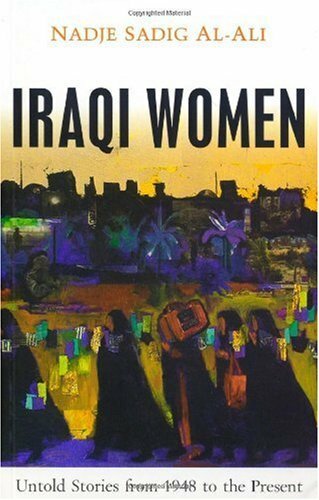 Nadje Al-Ali went on to give an engaging account of women’s situation and activism in Iraq from 1948 to the present. It seems that the two decades before and after the 1958 revolution were boom years for the women’s movement: the Iraqi Women’s League reached its peak of 40,000 members, and photographs show large numbers of women taking part in demonstrations, with few wearing the niqab (face veil) that is seen more commonly today. In the 1970s, women benefitted from economic growth and the Ba’athist regime, though repressive, promoted women’s education and participation in the labour force. However, during the war between Iran and Iraq in the 1980s, the rhetoric shifted to a focus on woman’s role as the mother of future soldiers. Contraception and abortion were made illegal.
Professor Al-Ali argued that the comprehensive economic sanctions imposed on Iraq by the UN Security Council from 1990 had a devastating impact on the lives of ordinary people, especially women. High unemployment led to a push for women to leave their jobs and stay at home. Large numbers of men had been killed or had migrated, and this gender imbalance in the population led to an increase in polygamy. There was also an increase in prostitution and, as a reaction to this, a greater focus on safeguarding women’s honour and wearing modest clothing. For Al-Ali, the effects of the sanctions against Iraq are important in providing a context for the US-led invasion of 2003 and the events that followed.

© Eugenie Dolberg, Open Shutters project
Nadje Al-Ali explained that, since 2003, women in Iraq have suffered violence, rape and torture from all sides of the conflict – occupation forces as well as militias fighting for and against the government. For her, women’s bodies have become both a physical and metaphorical means of asserting control in the struggle over territory and resources. She said that while women have been left to pick up the pieces of a dysfunctional state, they are still fighting for their place in the new constitution. Women’s rights activists campaigned for a quota to ensure female representation in politics, and after their initial request for 40%, a quota of 25% was included in the constitution. However, it was implemented in Parliament but not the Ministries or the Constitutional Review Committee. Professor Al-Ali pointed out further limitations of the quota, citing lack of political experience and the risks of running for public office as barriers to women’s participation.
Professor Al-Ali ended her talk by challenging the idea that violence against women is somehow ‘inherent’ in Islamic or Middle Eastern culture. She reiterated her argument that contexts are key, and her warning that ‘imperialist feminism’ can cause a backlash against women’s rights. She illustrated her point with a recent photograph, taken in Iraq after 2003, of a group of fully veiled women – a strict dress code that she said has become a feature of Iraqi life since (not before) the invasion. Nadje Al-Ali’s final, powerful message was that women’s rights have to come from within.
*
By Emma Jackson Stuart ~ 10 March 2011
*
*
Links
*
International Women’s Day: www.internationalwomensday.com
IWD events in Cambridge (27th February – 17th March): www.cambridge.gov.uk/iwd
*
Nadje Al-Ali: http://en.wikipedia.org/wiki/Nadje_Sadig_Al-Ali
‘The battle against brutality for women in Iraq’ (Guardian, January 2009)
Act Together – women’s action for Iraq: www.acttogether.org
Iraqi Women’s League: www.iraqiwomensleague.com
No comments yet